Stories carried ashore
Every surfboard design is a physical record of the wave it was built to ride and the timber or composite available in that harbour at that moment. To understand why coastal towns behave the way they do, you have to trace the craft that brought people into the surf zone.
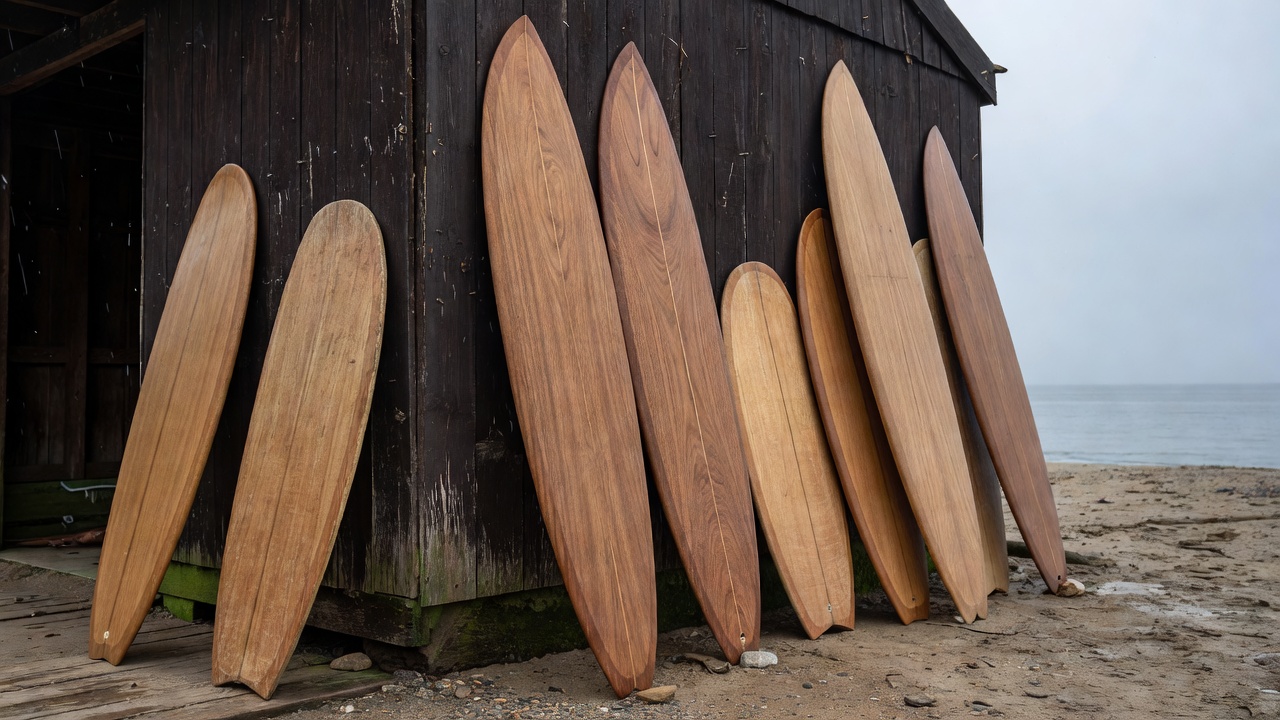
1. Polynesia & Hawaiʻi: Heʻe Nalu as civic and spiritual architecture
Wave riding—known in ʻŌlelo Hawaiʻi as heʻe nalu ("wave sliding")—was never a peripheral pastime in ancient Hawaiʻi; it was woven into religious observance, genealogical chants (mele), and social seasonal cycles. During the Makahiki harvest season (roughly October to February, coinciding with big North Pacific winter swells), work on the land paused and communities gathered at prime breaks from Waikīkī and Haleʻiwa on Oʻahu to Kahaluʻu on Hawaiʻi Island.
Three primary board classes defined the craft: the compact paipo (ridden prone or on the knees), the thin-railed finless alaia measuring seven to twelve feet long for steep breaking waves, and the thick-bellied olo extending up to eighteen feet, shaped from buoyant wiliwili wood and reserved for aliʻi (royalty). Today, original boards preserved in the Bernice Pauahi Bishop Museum in Honolulu demonstrate how early Hawaiian shapers mastered bottom contours—subtle convex hulls transitioning to flat planing surfaces—centuries before Western naval architects studied planing hydrodynamics.
2. Santa Cruz, Waikīkī & Freshwater: The Pacific timber exchange (1885–1915)
In July 1885, three Hawaiian princes—David Kawānanakoa, Edward Keliʻiahonui, and Jonah Kūhiō Kalanianaʻole—Studying at St. Matthew’s Hall in San Mateo commissioned local millworkers in Santa Cruz, California, to shape three coastal redwood planks over fifteen feet long, riding them at the San Lorenzo River mouth. Three decades later, Olympic champion Duke Paoa Kahanamoku carried the Ambassadorial flame of Hawaiian surfing to both coasts of the United States and to Australia and New Zealand.
When Kahanamoku shaped an 8'9" board out of solid Australian sugar pine at Hudson’s timber yard in Sydney and paddled out at Freshwater Beach during the summer of 1914–1915, he sparked a durable civic institution: the Australian Surf Life Saving Club (SLSC). Across New South Wales and Queensland, beach towns organized volunteer surf patrols, surf-boat rowing crews, and board-building sheds that still anchor the beachfront promenade of almost every Australian coastal suburb.
3. Cornish coffin-lids, Tom Blake’s hollow hulls & the Biarritz Tontons
Simultaneously, independent wave-riding traditions emerged along cold Atlantic beaches. In early 20th-century Cornwall and Devon, local undertakers and joiners shaped four-foot boards out of thin elm or steamed birch plywood with a turned-up nose. Known simply as "surf-boards" (and later bellyboards), they were ridden prone in the whitewater and shorebreak by residents of all ages—a tradition celebrated each autumn at the World Bellyboarding Championships in Chapel Porth.
Meanwhile, in 1926, Wisconsin-born swimmer and inventor Tom Blake studied the ancient olo boards at the Bishop Museum and built a 15-foot hollow redwood paddleboard reinforced with internal bulkheads. Nine years later, Blake glassed a salvage speedboat slip-keel onto the tail of a board, introducing the fixed surfboard fin. By 1956, Hollywood screenwriter Peter Viertel brought two California fibreglass boards to Biarritz while filming The Sun Also Rises. Joined by local pioneers Joël de Rosnay, Jacky Rott, and Michel Barland—affectionately remembered as the Tontons Surfeurs—they began manufacturing foam-and-fibreglass boards in Bayonne, turning the Côte Basque into Europe’s surfboard laboratory.
4. The modern neighborhood shaper’s bay
Walk down a quiet lane in St Agnes, Anglet, or Byron Bay today and the most vital guardian of surf heritage is still the hand-shaper working in a side-lit room with a Modified Skil 100 planer. While mass-produced epoxy boards arrive by container ship, independent shapers calibrate rocker curves, rail volume, and fin foil specifically for the local bathymetry—knowing exactly how a step-deck longboard needs to nose-ride across a shallow sandbar or how a quad-fin fish handles a wind-chopped point.
Visiting a local shaping loft respectfully
A shaping room is a precision workshop where airborne dust, wet laminating resin, and tight delivery schedules rule the day. Always call or email ahead before dropping in; never run your fingers along an unglassed foam blank (skin oils ruin resin adhesion); and if you stay for a coastal season, commission a board locally rather than flying three fragile boards across oceans.
Plan a Slow Getaway